Uncertainty has investors on the defensive.
Uncertainty in capital markets is running rampant and putting investors on the defensive. While it never feels good to see declines, they are actually a frequent occurrence. As always—but especially in turbulent times—we believe diversification is the best defense against volatility.
Stay the course
Our view is to fully diversify your portfolio, maintain it in line with your risk tolerance, stay invested, and don’t panic—these are some of the core investing principles that we always come back to in turbulent times. While this advice has served long-term investors well, it’s also human nature to question it when markets decline. Although the exact reasons for market downturns are always different, the core principles of sound advice remain the same for any market environment, including today.
Market dips happen often
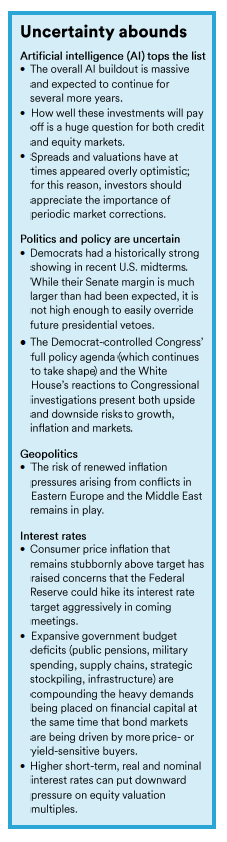
Uncertainty abounds in capital markets today—we review the major concerns in the blue call-out box on the next page. When uncertainty rises to this level, there are typically some declines to follow. U.S. stocks have borne the brunt of them thus far. U.S. equities, as measured by the broad-market S&P 500 Index and at the time of this writing, suffered a greater than 10% decline (the level of losses that technically define a market correction) from the recent all-time highs, with a notable recovery the next trading day. Losses of this magnitude are not an unusual occurrence (as shown in Exhibit 1) despite being unsettling to many investors.
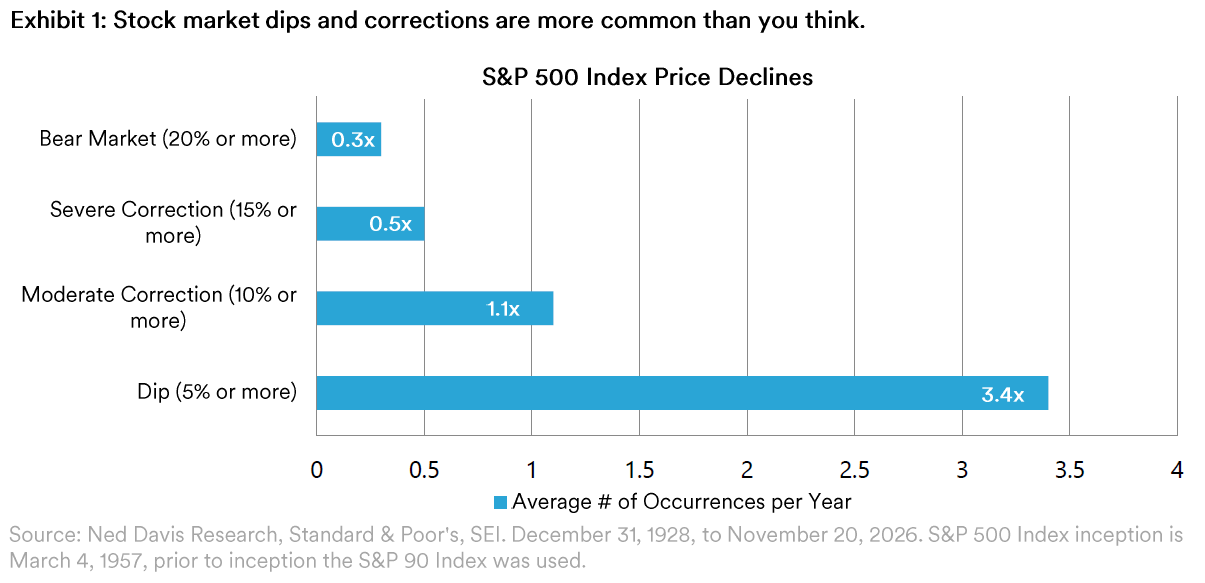
As seen in Exhibit 1, market losses in the 5 %-10% range occur on average more than three times a year. It’s also common (about once a year) to see declines of 10% or more. Obviously, more significant downturns can and do occur, but with much less frequency. It’s important to remember that when looking at long - term market returns, those returns include staying invested during the dips, corrections, and even bear markets — this is a critical component as to why SEI preaches staying invested.
Diversification can help
Diversification does not eliminate the risk of losses, but it can help produce a smoother ride by investing in assets with lower correlations to each other. Shortly after the U.S. midterm elections and the surprise removal of a high - profile AI chief executive , U.S. stocks , as measured by the S&P 500 Index , began to sell off after a one -day, post - election rally . Concerns about current AI leadership, elevated investment levels, inflation and central bank policies, and the potential for new AI regulations at the federal and state levels helped fuel a bout of investor risk aversion. While the rough S&P 500 sessions that occurred on November 5 and 20 weren’t the worst on record over the past 10 years, they did rank 11th and 18th, respectively per our research . It’s also worth noting that ,based on our research, more than three quarters of the worst daily trading sessions over the last 10 years have occurred in this decade — reminding investors once again that we are in a very different world than the one that prevailed between the global financial crisis and the on set of SARS -COV - 2.
What is SEI doing?
We believe the market conditions have been favorable for active management for some time now and we will continue to invest where we see opportunities. One opportunity is the theme of “sticky inflation” — in our dynamic portfolios (not available in Canada) , we are positioned for inflation to continue above the Fed’s 2% target for longer than markets are anticipating. We also emphasize value stocks — those that we believe trade below their perceived fair market value — which has resulted in a corresponding underweight to the high - flying growth stocks that have characterized the AI trades.
As always, our belief is to remain diversified in your portfolios . If you have not reviewed your risk tolerance and goals recently, now may be a good time to do so to ensure that your investments are aligned with them.
GLOSSARY AND INDEX DEFINITIONS
For financial term and index definitions, please see: https://www.seic.com/ent/imu -communications - financial -glossary
IMPORTANT INFORMATION
This material represents an assessment of the market environment at a specific point in time and is not intended to be a fore cast of future events or a guarantee of future results. All information as of the date indicated. There are risks involved with investing, including possible loss of principal. This information should not be relied upon by the reader as research or investment advice, (unless you have otherwise separately entered into a written agreement with SEI for the provision of investment advice) nor should it be construed as a recommendation to purchase or sell a security. The reader should consult with their financial professional for more information.
Diversification may not protect against market risk. Statements that are not factual in nature, including opinions, projections and estimates, assume certain economic conditions and industry developments and constitute only current opinions that are subject to change without notice. Nothing herein is intended to be a forecast of future events, or a guarantee of future results.
Index returns are for illustrative purposes only, and do not represent actual performance of an SEI Fund. Index returns do no t reflect any management fees, transaction costs or expenses. Indexes are unmanaged and one cannot invest directly in an index. Pas t performance does not guarantee future results.
Certain economic and market information contained herein has been obtained from published sources prepared by other parties, which in certain cases have not been updated through the date hereof. While such sources are believed to be reliable, neither SEI n or its affiliates assumes any responsibility for the accuracy or completeness of such information and such information has not been independently verified by SEI.
The information contained herein is for general and educational information purposes only and is not intended to constitute l egal, tax, accounting, securities, research or investment advice regarding the strategies or any security in particular, nor an opinion regarding the appropriateness of any investment. You should not act or rely on the information contained herein without obtaining specific legal, tax, accounting and investment advice from an investment professional.
The views contained herein are not to be taken as advice or a recommendation to buy or sell any investment in any jurisdiction. Our outlook contains forward -looking statements that are judgments based upon our current assumptions, beliefs, and expectations . If any of the factors underlying our current assumptions, beliefs or expectations change, our statements as to potential future events or outcomes may be incorrect. We undertake no obligation to update our forward -looking statements.
Information in the U.S. is provided by SEI Investments Management Corporation (SIMC), a wholly owned subsidiary of SEI Investments Company (SEI).
Information in Canada is provided by SEI Investments Canada Company, a wholly owned subsidiary of SEI Investments Company (SE I), and the Manager of the SEI Funds in Canada.
Information issued in the UK by SEI Investments (Europe) Limited, 1st Floor, Alphabeta, 14 -18 Finsbury Square, London EC2A 1BR which is authorised and regulated by the Financial Conduct Authority. Investments in SEI Funds are generally medium - to long -term investments.
This information is made available in Latin America, the Middle East, the Nordics, and Australia FOR PROFESSIONAL (non - retail) USE ONLY by SIEL.
Any questions you may have in relation to its contents should solely be directed to your Distributor. If you do not know who your Distributor is, then you cannot rely on any part of this document in any respect whatsoever.
Issued in South Africa by SEI Investments (Europe) Ltd, anauthorised financial services provider (FSP No. 9796). This material is provided for general information and educational purposes only and does not constitute financial advice as contemplated in the Financial Advisory and Intermediary Services Act, 2002. It has not been prepared with regard to the investment objectives, financial situation or particular needs of any individual investor. Any reference to portfolio positioning represents SEI's investment views at the date of publication and may differ between portfolios and mandates. Investors should obtain appropriate professional advice before making an investment decision.