Local currency: Shifting into resilience.
Something has changed in how emerging-market (EM) debt reacts to bad news: Local-currency EM debt appears to have become more resilient over time, better able to absorb shocks, limit the damage, and recover afterwards. Three reinforcing developments help explain this shift: steadier external fundamentals, a deepening domestic investor base, and monetary policy frameworks that markets have begun to trust. At the same time, some of the fiscal and policy risks historically associated with emerging markets have become more visible in developed markets, particularly the U.S.
In the early development of local-currency bond markets in the late 1990s and early 2000s, markets were shallower and domestic institutional investor bases less developed, leaving them more exposed to shifts in foreign investor flows and global risk appetite. Current account deficits also left many EM economies dependent on foreign capital inflows, increasing their vulnerability when global investor risk appetite deteriorated.
Monetary regimes lacked credibility, and with reserve buffers much less developed than they are today, central banks had less scope to use foreign exchange (FX) intervention to manage currency pressure. This left them more reliant on aggressive interest-rate hikes to defend their currencies and stem capital outflows, which only compounded the damage to growth and bond prices. And because so much EM debt was U.S. dollar-denominated, currency weakness raised the real cost of servicing the debt, turning what began as a market selloff into a test of a country’s solvency.
Steadier external fundamentals
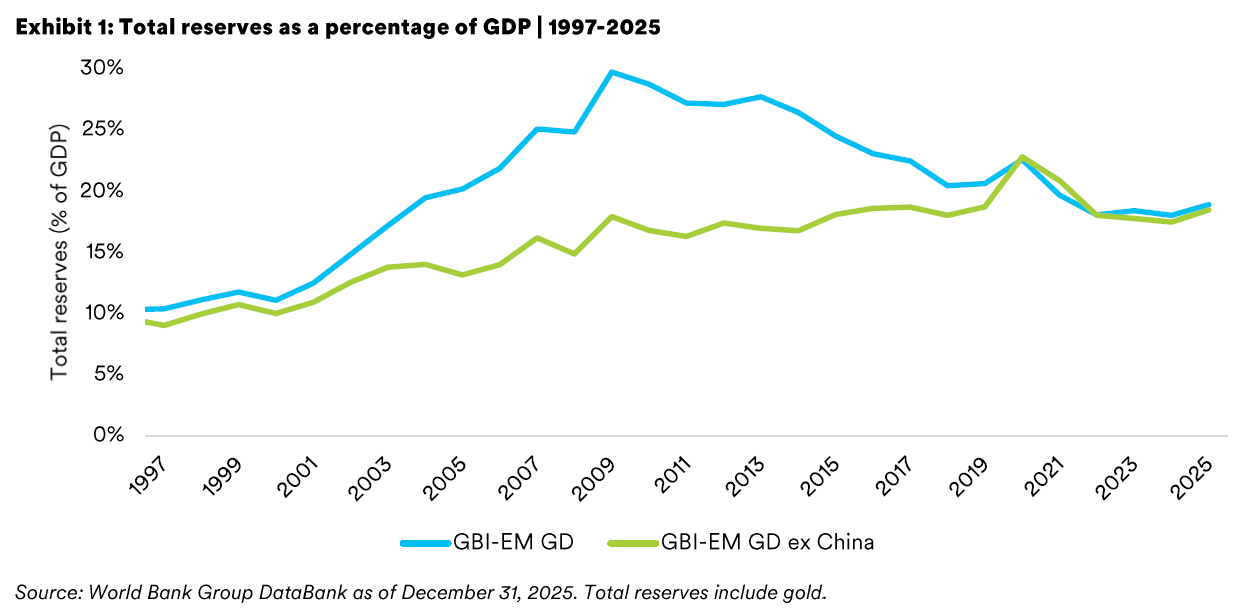
The first of these developments, steadier external fundamentals, shows up in both stronger reserve buffers and reduced reliance on external and foreign-currency financing. EM FX reserves have grown materially relative to the size of their economies over the past three decades. Across a 19-country sample, reserves (excluding China) have roughly doubled as a share of gross domestic product (GDP) since the Asian financial crisis of 1997, from approximately 9% to roughly 18%. Including China, the ratio peaked near 30% in 2009, reflecting China’s large external surpluses and the central bank’s accumulation of foreign-exchange reserves while managing the renminbi. The aggregate ratio subsequently eased to around 19% as China's own reserve-to-GDP ratio fell. Exhibit 1 shows both measures over this period.
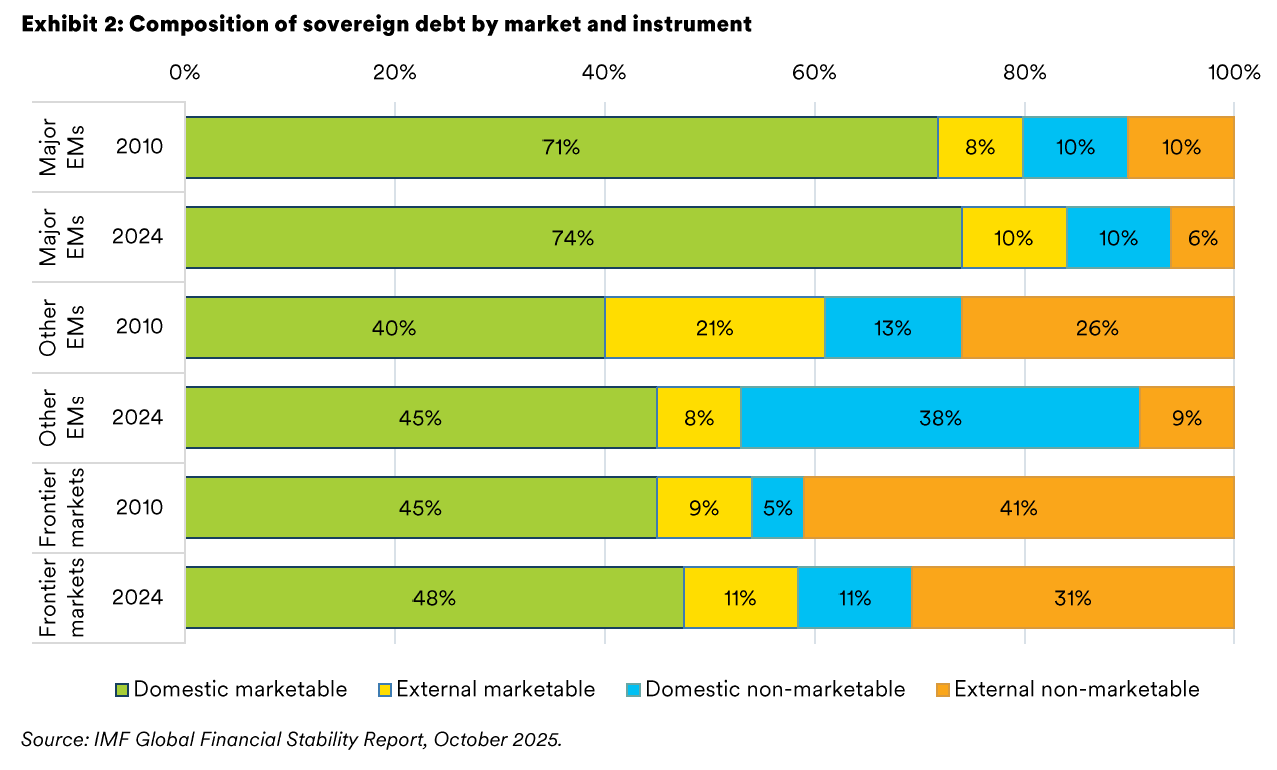
The improvement is also visible on the liability side. As Exhibit 2 indicates, EM sovereign debt financing has become increasingly domestically oriented, with reliance on external markets declining across major EMs, other EMs and frontier markets between 2010 and 2024. Along with this shift towards domestic financing, EM sovereigns have also reduced their reliance on foreign-currency debt. This makes them less susceptible to the well-documented “original sin” problem that contributed to Mexico’s Tequila Crisis in 1994, when the government of Mexico devalued the peso by 15% versus the U.S. dollar. That is, lower reliance on foreign-currency debt means that currency depreciation is less likely to inflate debt-servicing costs and turn an FX shock into a threat to sovereign solvency.
Deepening domestic investor base
The second development is a deepening domestic investor base, which has helped enable the shift towards domestic and local-currency financing described above. Pension funds, insurers, and banks have built out the local buyer base that was less developed during the Asian crisis or the spike in U.S. Treasury yields during the “taper tantrum” in 2013, giving these markets a shock absorber that is less dependent on foreign sentiment. As that buyer base has grown and become more differentiated, sovereign bonds have also been able to develop fuller yield curves, allowing them to spread issuance across short, intermediate and long maturities and better match supply with different sources of demand. Structural reforms to market infrastructure, regulation, and debt management have reinforced this shift, helping deepen local capital markets and broaden the funding options available to sovereigns. The International Monetary Fund’s (IMF) 2025 assessment credits this shift directly. Deeper domestic ownership, it finds, has reduced both currency mismatch and the market's exposure to non-resident outflows―two channels that made the old episodes quite volatile.1
Monetary policy credibility
The third development is improved monetary policy credibility. This is more difficult to observe directly than reserve accumulation or the composition of sovereign debt, but there is evidence that EM monetary policy frameworks has strengthened and inflation expectations have become better anchored. The IMF finds that monetary policy implementation and credibility have improved across emerging markets, strengthening their ability to withstand risk-off shocks. Better-anchored expectations reduce the pass-through of currency depreciation into domestic prices, allowing external shocks to be absorbed with less risk of developing into a broader loss of policy credibility.2
With stronger external balances and more credible policy frameworks, central banks are less likely to be forced into panic-generated rate hikes to defend currencies under pressure. The 2022 calendar year shows this in practice. The selloff was global and hit every major asset class, and local-currency debt fell sharply, but EM central banks were in a different position from past episodes. Brazil, the Czech Republic, and Hungary, for example, had all begun tightening monetary policy in 2021, ahead of the Federal Reserve (Fed) in the U.S., giving them greater room to allow their currencies to absorb some of the initial shock while continuing their existing hiking cycles. That helps explain why the old sequence of panic-generated rate hikes giving way to selloffs did not repeat itself.
Limits to resilience
It is worth qualifying what has been written so far. Firstly, de-dollarizing the debt doesn't fully de-dollarize the risk. Foreign ownership concentration still matters for how local markets absorb shocks. The IMF conducted analyses across 14 emerging markets from 2012 to 2024, which illustrates this sensitivity. At the cross-country average non-resident ownership level of 22%, its model estimates that a 10-point increase in the CBOE Volatility Index (VIX) is associated with a 19-basis-point increase in five-year local-currency yield spreads. At 34% ownership, that sensitivity rises to 23 basis points.3 This suggests that deeper domestic markets reduce external vulnerability, but high foreign participation can still transmit shifts in global risk sentiment into local yields.
Secondly, the story isn't uniform across all EM countries. EMs span countries as different as China, where the one-year Loan Prime Rate was 3% as of October 31, 2026, and Turkey, where the policy rate stood at 36% 4―a dispersion that maps onto very different levels of institutional depth and monetary credibility. Mexico and Poland, with over two decades of inflation-targeting track records and a genuine domestic pension base, are two examples of the mechanisms described above. Countries closer to the other end of the spectrum are likely still closer to the old pattern than the aggregate numbers suggest, a distinction the aggregate resilience data in this paper cannot fully resolve, and is therefore worth keeping in mind.
Shifting risk perceptions
It is difficult to write about improving EM fundamentals in 2026 without noting the contrasting developments in the developed markets. Particularly in the U.S., where federal debt has passed $40 trillion, the budget deficit is running near 6% of GDP, 5 and the 30-year Treasury yield recently hit levels last seen in 2004.6 Investors are demanding a term premium for inflation and fiscal concerns, while the Fed pulls back from forward guidance, creating some parallels with the risks historically associated with EMs. As the underlying characteristics of the two markets have evolved, their performance through periods of stress has also begun to converge.
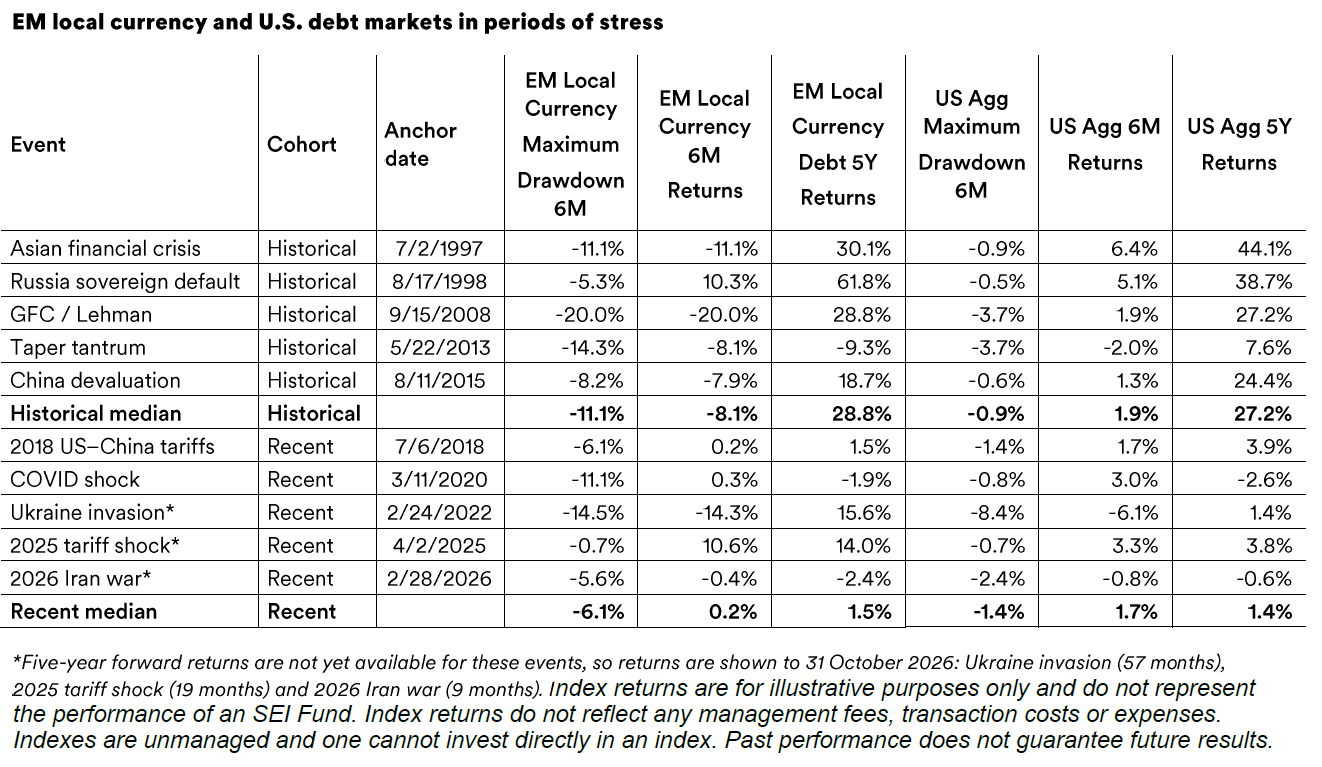
The 2025-26 U.S. tariff escalation, the Iran war, and the Russia-Ukraine war's continuing spillovers have provided varying degrees of stress across global markets; however local-currency EM debt has increasingly absorbed these shocks without amplifying them in the way it once did. On limiting the damage, drawdowns are smaller than in earlier episodes, although this partly reflects the relatively milder reactions of markets to shocks across 2025 and 2026. On a median basis, EM local-currency bonds still fall further than U.S. investment-grade securities (as measured by the Bloomberg US Aggregate Bond Index) in a shock, but the gap has narrowed. On recovery, outcomes following earlier crises varied considerably, whereas in more recent episodes, median six-month returns have been broadly comparable with those of U.S. investment-grade bonds, and longer-run returns have also compared favorably.
None of this means that local-currency EM debt is insulated from global shocks. What has changed, however, is how the asset class appears to absorb them. It offers a more resilient risk profile: shallower drawdowns on average than in earlier shocks, stronger returns after shocks relative to U.S. investment-grade bonds, stronger external buffers, a deeper domestic investor base, and more credible monetary policy frameworks. At a time when stability is harder to take for granted in the traditional ”safe” end of a portfolio, local-currency EM debt merits consideration as part of an investor's core allocation.
GLOSSARY AND INDEX DEFINITIONS
For financial term and index definitions, please see: https://www.seic.com/ent/imu-communications-financial-glossary
IMPORTANT INFORMATION
This material represents an assessment of the market environment at a specific point in time and is not intended to be a forecast of future events or a guarantee of future results. All information as of the date indicated. There are risks involved with investing, including possible loss of principal. This information should not be relied upon by the reader as research or investment advice, (unless you have otherwise separately entered into a written agreement with SEI for the provision of investment advice) nor should it be construed as a recommendation to purchase or sell a security. The reader should consult with their financial professional for more information. Diversification may not protect against market risk. Bonds and bond funds will decrease in value as interest rates rise. High yield bonds involve greater risks of default or downgrade and are more volatile than investment grade securities, due to the speculative nature of their investments.
Statements that are not factual in nature, including opinions, projections and estimates, assume certain economic conditions and industry developments and constitute only current opinions that are subject to change without notice. Nothing herein is intended to be a forecast of future events, or a guarantee of future results.
Certain economic and market information contained herein has been obtained from published sources prepared by other parties, which in certain cases have not been updated through the date hereof. While such sources are believed to be reliable, neither SEI n or its affiliates assumes any responsibility for the accuracy or completeness of such information and such information has not been independent ly verified
by SEI.
The information contained herein is for general and educational information purposes only and is not intended to constitute l egal, tax,accounting, securities, research or investment advice regarding the strategies or any security in particular, nor an opi nion regarding the appropriateness of any investment. You should not act or rely on the information contained herein without obtaining specific legal, tax,
accounting and investment advice from an investment professional.
The views contained herein are not to be taken as advice or a recommendation to buy or sell any investment in any jurisdictio n. Our outlook contains forward -looking statements that are judgments based upon our current assumptions, beliefs, and expectations . If any of the factors underlying our current assumptions, beliefs or expectations change, our statements as to potential future events or outcomes may be incorrect. We undertake no obligation to update our forward -looking statements.
Information in the U.S. is provided by SEI Investments Management Corporation (SIMC), a wholly owned subsidiary of SEI Invest ments Company (SEI).
Information in Canada is provided by SEI Investments Canada Company, a wholly owned subsidiary of SEI Investments Company (SE I), and the Manager of the SEI Funds in Canada.
Information issued in the UK by SEI Investments (Europe) Limited, 1st Floor, Alphabeta, 14 -18 Finsbury Square, London EC2A 1BR which is authorised and regulated by the Financial Conduct Authority. Investments in SEI Funds are generally medium - to long -term investments.
The contents of this document have not been reviewed by any regulatory authority in Hong Kong. You are advised to exercise ca ution in relation to the offer. If you are in any doubt about any of the contents of this document, you should obtain independent p rofessional advice.
This information is made available in Latin America, the Middle East, the Nordics, and Australia FOR PROFESSIONAL (non -retail) USE ONLY by SIEL.
Any questions you may have in relation to its contents should solely be directed to your Distributor. If you do not know who your Distributor is, then you cannot rely on any part of this document in any respect whatsoever.
Issued in South Africa by SEI Investments (Europe) Ltd, an authorised financial services provider (FSP No. 9796). This materi al is provided for general information and educational purposes only and does not constitute financial advice as contemplated in th e Financial Advisory and Intermediary Services Act, 2002. It has not been prepared with regard to the investment objectives, financial situation or pa rticular needs of any individual investor. Any reference to portfolio positioning represents SEI's investm ent views at the date of publication and may differ between portfolios and mandates. Investors should obtain appropriate professional advice before making an investment decision.