Central bank depository: Maintaining the status quo with an asterisk.
SEI’s view
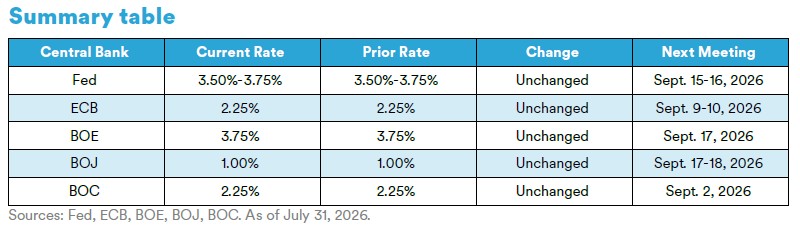
While the Federal Reserve (Fed) elected to remain on hold again during its July meeting, the chorus supporting a near-term interest-rate hike continues to grow louder. Notably, three Fed officials dissented in favor of raising rates, underscoring a willingness among some monetary policymakers to respond to persistent inflationary pressures and continued economic resilience. With the Fed now entering its summer recess ahead of the September meeting, SEI and avid Fed watchers alike will be closely parsing public comments from central bank officials for clues as to whether this groundswell of support for tighter policy continues to build. Despite the recent rise in U.S. Treasury yields, SEI believes that inflation risks remain skewed toward the upside over the near term. Elsewhere, both the European Central Bank (ECB) and the Bank of England (BOE) have adopted a cautiously hawkish tone as higher energy prices threaten to place upward pressure on inflation, particularly in economies that remain vulnerable to oil-price shocks. Unlike the U.S., where inflation has been supported by relatively resilient economic growth and domestic demand, inflation risks in Europe and the U.K. are more closely tied to supply-side factors, particularly energy costs and their potential spillover effects across the broader economy. As a result, central banks face the difficult task of balancing persistent inflation risks against relatively subdued growth prospects and softer underlying economic momentum. The balance of risks remains tilted toward higher near-term inflation and the possibility of additional rate hikes. Several of these concerns also remain evident in Canada, where economic growth has been relatively subdued. However, inflation risks are somewhat less pronounced given the country's status as a net energy exporter.
Federal Reserve (Fed)
- In a split 9-3 vote, the Federal Open Market Committee (FOMC) maintained the federal funds rate in a range of 3.50% to 3.75% at its meeting on July 28-29. Three regional Federal Reserve Bank presidents favored a rate increase of 0.25%.
- In its statement announcing the rate decision, the FOMC cited the stability of the U.S. economy. “Economic activity is expanding at a solid pace despite elevated uncertainty that owes, in part, to the conflict in the Middle East,” the FOMC said. “Inflation remains elevated relative to the Committee’s 2 percent goal, in part reflecting supply shocks that have driven price increases in certain sectors, including energy.”
- During a news conference following the FOMC meeting, Fed Chair Kevin Warsh emphasized the central bank's commitment to its 2% target inflation rate. "Let me reiterate: There is no soft inflation target, there is no soft implicit target, not on [the FOMC's] watch," he said. Warsh also addressed the three dissenting votes favoring a rate hike. "There was a disagreement about a decision today," he noted. "I would say that doesn't sort of capture the full essence of the discussion.”
European Central Bank (ECB)
- The ECB voted unanimously to maintain its benchmark interest rate at 2.25% at its July 22-23 meeting, citing the Mideast conflict’s impact on the European economy.
- In a news release, the ECB’s Governing Council commented, “The outlook for energy prices, while highly volatile, currently stands close to the baseline of the June Eurosystem [the central banking system and monetary authority of the euro region] staff projections and well above the levels recorded prior to the conflict in the Middle East. Uncertainty remains high and the full inflationary impact of the energy shock has yet to play out.
- In prepared remarks for a news conference following the rate announcement, ECB President Christine Lagarde and Vice President Boris Vujčić stated, “With today’s decision, we remain well positioned to navigate the uncertainty caused by the [Middle East] conflict.” Lagarde and Vujčić also noted that inflation continues to weigh on the economy of the euro region. “The energy shock could intensify further and its effects on other prices and wages could be stronger than currently expected,” they said. “The longer energy prices stay high, the more likely they are to drive up broader inflation through indirect and second-round effects.”
Bank of England (BOE)
- At its meeting on June 29, the BOE voted by a margin of 6-3 to maintain the Bank Rate at 3.75%, citing the probability of persistently higher energy prices amid the ongoing Mideast war. Three Monetary Policy Committee (MPC) members supported a 0.25% rate increase.
- The MPC stated, “The impact of the energy shock on the UK economy remains uncertain. Monetary policy cannot influence energy prices but is being set to ensure that the economic adjustment to them occurs in a way that achieves the 2% inflation target sustainably. The policy stance required to achieve this will depend on the scale and duration of the shock, and how it propagates through the economy including via financial conditions.”
- The central bank’s announcement provided insights into the views of the MPC members. Megan Greene, who favored a 0.25% rate hike, commented, “There remains considerable uncertainty about the evolution of the conflict in Iran and its impact on the U.K. economy. Incoming data suggests the disinflation process has continued and the real side of the economy remains soft… [T]here is significant uncertainty about which projection or scenario is most likely and I believe a risk management strategy is appropriate.”
Bank of Japan (BOJ)
- At its meeting on July 30, the BOJ voted by an 8-1 majority to maintain its benchmark interest rate at a 31-year high of 1.00%. Board member Hajime Takata favored a 0.25% rate hike.
- In a statement announcing the rate decision, the central bank commented, “For the time being, it is necessary to pay particular attention to the impact of the situation in the Middle East on financial and foreign exchange markets and on Japan's economic activity and prices. In addition, it is necessary to pay attention to the effects of developments in global AI-related demand and of future developments in foreign exchange rates on Japan's economic activity and prices.”
- At a news conference following the meeting, BOJ Governor Kazuo Ueda appeared to leave open the possibility of rate increases going forward. “At a time when there is a risk of underlying inflation overshooting, delaying necessary policy action could materialize such a risk and hurt the economy,” he said. “Given that underlying inflation is approaching our 2% target, we must scrutinize upside price risks more than ever.”
Bank of Canada (BOC)
- For the sixth time in a row, the BOC maintained its policy rate at 2.25% following its July 15 meeting.
- In a statement announcing the monetary policy decision, the central bank noted the economic impact of the ongoing Mideast conflict. “[G]lobal economic prospects have been dented by higher oil prices stemming from the Middle East conflict,” the BOC stated. “Oil prices are still lower than their peak in April but the situation in the Middle East remains volatile. The path for global inflation is highly dependent on how the conflict unfolds.”
- At a news conference following the interest-rate announcement, BOC Governor Tiff Macklem did not rule out future rate hikes. “Governing Council judges the current policy rate remains appropriate to sustain the economic recovery and bring inflation back to the 2% target,” he said. “However, uncertainty is still high. Governing Council will continue to assess the strength of the Canadian economy and the outlook for inflation and is prepared to adjust monetary policy as needed.”
GLOSSARY AND INDEX DEFINITIONS
For financial term and index definitions, please see: https://www.seic.com/ent/imu-communications-financial-glossary
IMPORTANT INFORMATION
This material represents an assessment of the market environment at a specific point in time and is not intended to be a forecast of future events or a guarantee of future results. All information as of the date indicated. There are risks involved with investing, including possible loss of principal. This information should not be relied upon by the reader as research or investment advice, (unless you have otherwise separately entered into a written agreement with SEI for the provision of investment advice) nor should it be construed as a recommendation to purchase or sell a security. The reader should consult with their financial professional for more information.
Statements that are not factual in nature, including opinions, projections, and estimates, assume certain economic conditions and industry developments and constitute only current opinions that are subject to change without notice. Nothing herein is intended to be a forecast of future events, or a guarantee of future results,
Certain economic and market information contained herein has been obtained from published sources prepared by other parties, which in certain cases have not been updated through the date hereof. While such sources are believed to be reliable, neither SEI nor its affiliates assumes any responsibility for the accuracy or completeness of such information and such information has not been independently verified by SEI.
There are risks involved with investing, including loss of principal. The value of an investment and any income from it can go down as well as up. Investors may get back less than the original amount invested. Returns may increase or decrease as a result of currency fluctuations. Past performance is not a reliable indicator of future results. Investment may not be suitable for everyone.
This material is not directed to any persons where (by reason of that person's nationality, residence or otherwise) the publication or availability of this material is prohibited. Persons in respect of whom such prohibitions apply must not rely on this information in any respect whatsoever.
The information contained herein is for general and educational information purposes only and is not intended to constitute legal, tax, accounting, securities, research or investment advice regarding the strategies or any security in particular, nor an opinion regarding the appropriateness of any investment. This information should not be construed as a recommendation to purchase or sell a security, derivative or futures contract. You should not act or rely on the information contained herein without obtaining specific legal, tax, accounting, and investment advice from an investment professional.
Information in the U.S. is provided by SEI Investments Management Corporation (SIMC), a wholly owned subsidiary of SEI Investments Company (SEI).
Information in Canada is provided by SEI Investments Canada Company, a wholly owned subsidiary of SEI Investments Company (SEI), and the Manager of the SEI Funds in Canada.
In the UK and the EEA this information issued in the UK by SEI Investments (Europe) Ltd, 1st Floor, Alphabeta, 14-18 Finsbury Square, London EC2A 1BR which is authorised and regulated by the Financial Conduct Authority.
The contents of this document have not been reviewed by any regulatory authority in Hong Kong. You are advised to exercise caution in relation to the offer. If you are in any doubt about any of the contents of this document, you should obtain independent professional advice.
This document has not been registered as a prospectus with the Monetary Authority of Singapore.
This information is made available in Latin America and the Middle East FOR PROFESSIONAL (non-retail) USE ONLY by SIEL.
Any questions you may have in relation to its contents should solely be directed to your Distributor. If you do not know who your Distributor is, then you cannot rely on any part of this document in any respect whatsoever.
Issued in South Africa by SEI Investments (South Africa) (Pty) Limited FSP No. 13186 which is a financial services provider authorised and regulated by the Financial Sector Conduct Authority (FSCA). Registered office: 3 Melrose Boulevard, 1st Floor, Melrose Arch 2196, Johannesburg, South Africa.