Rethinking place-based investing: A whole-portfolio approach to local impact.
Place-based investing is a strategic approach to allocating capital with the explicit aim of addressing the unique needs and challenges of specific communities, particularly those facing economic hardship or lacking adequate access to infrastructure, employment opportunities, education, housing, and other critical resources. By intentionally directing investments into these often-underserved regions, institutional investors have an opportunity not only to pursue suitable, risk-adjusted financial returns, but also to enhance local economic resilience, prosperity, and long-term community development. This dual mandate aligns closely with the missions of many institutional investors, allowing them to support local priorities through their investment decisions alongside their daily program operations or grantmaking.
This paper aims to provide institutional investors with a comprehensive foundation for engaging with their investment committees, advisors, and other stakeholders around the concept and practice of place-based investing. It aims to clarify what it means to invest locally, offer guidance on executing place-based strategies across a range of impact areas and asset classes, and encourage the development of innovative solutions to meet community challenges. Through this exploration, institutional investors can be better equipped to address challenges and deliver durable, mission-aligned results in the places that matter most to them. While the concepts may have broad applicability, the examples, legal frameworks, investment structures, and market statistics are primarily U.S.-based and are intended for educational purposes. Product availability, regulatory treatment, tax consequences, and investment suitability vary by jurisdiction, and readers should not assume that the structures, opportunities, or considerations discussed are available or applicable in their local market.
What is a place?
A traditional view of place-based investing focuses on a specific city or metropolitan region. Investing directly in a local community can have tangible and measurable effects by injecting capital into local economies, funding housing and infrastructure projects, and supporting small businesses that generate jobs and other economic activity.
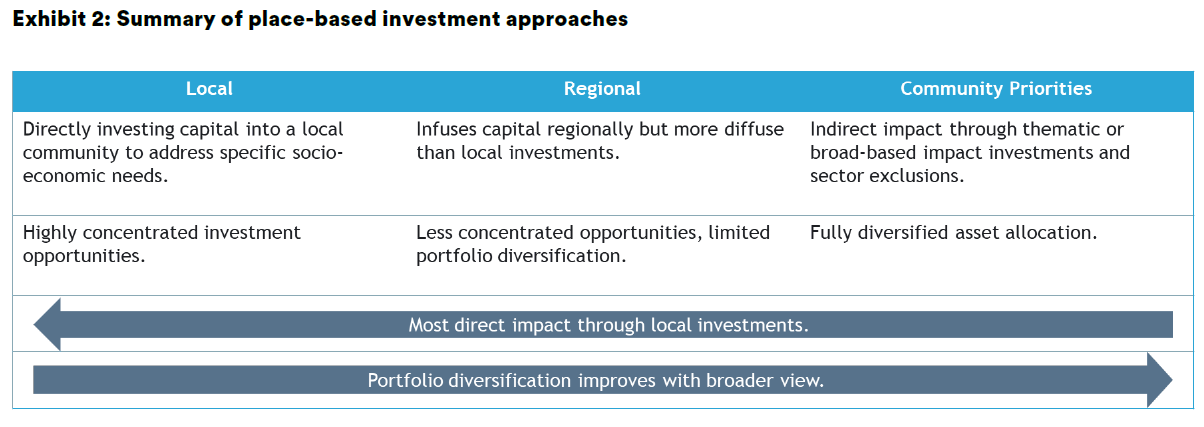
However, the traditional view of place-based investing may pose challenges for investors seeking broad market exposure and a well-diversified asset allocation strategy. Focused, local investing can lead to unintended portfolio concentration, while investment managers may face challenges sourcing enough investments for a well-diversified strategy. At SEI, we complement local investing with a more expansive view of “place” that goes beyond zip codes, city limits, or county lines.
Zooming out slightly, a regional lens may focus on a state or geographic region, particularly if there are regionally specific economic issues or growth engines. For example, the housing affordability challenges across California or reinvestments in manufacturing growth across the Midwest could offer investable solutions.
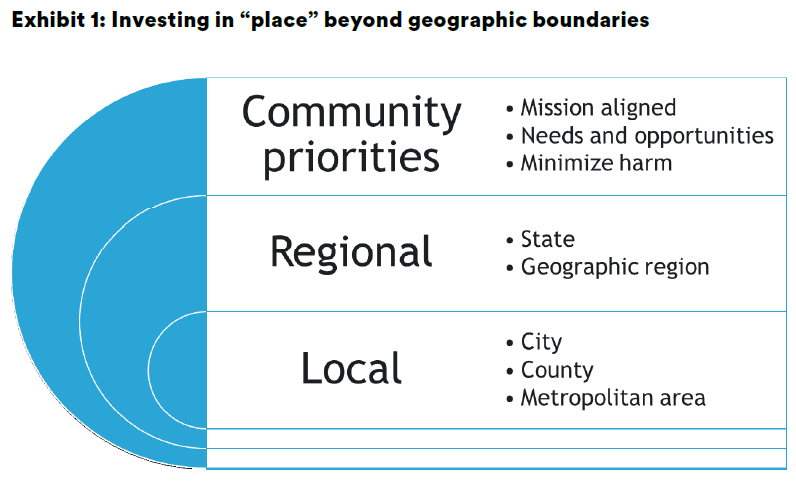
The widest lens offers views into a community’s unique priorities, regardless of where those investments are made. For example, urban and rural areas may have different opportunity sets for investments in transportation infrastructure or healthcare systems, and thematic investments in one direction or the other could support innovation or improve access to modern technologies. Investments in renewable energy may support environmental objectives in places where energy infrastructure investment needs are high. Similarly, avoiding investments in businesses that may exacerbate local challenges may align with place-based objectives for some investors.
Broadening the definition of place-based investing allows investors to better address local needs across asset classes, increase their impact, align with organizational objectives, and maintain a balanced asset allocation.
Institutions anchored in place
While all types of investors may show interest in place-based investing, nonprofit institutions often see place-based investing as an opportunity to align their assets with their mission and support mission-related objectives through capital allocation decisions for the communities they serve through their operations or grantmaking activities.
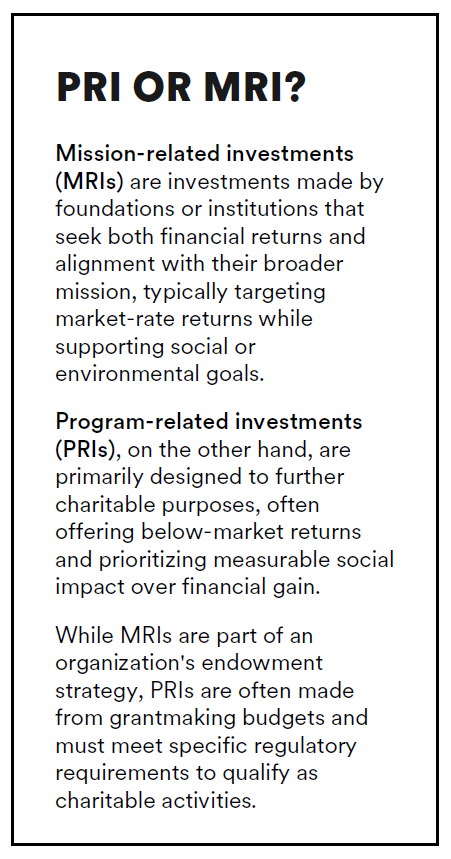
U.S.-based tax-exempt foundations are required by law to spend 5% of their assets each year in furtherance of their intended purpose. That leaves 95% of assets within investment portfolios, which could be invested traditionally or in more closely aligned mission objectives—commonly referred to as mission-related investing (MRI) or mission-aligned investing (MAI).
Community foundations
By definition, community foundations have made a commitment to a geographic region, with a focus on improving the lives of locals, whether through economic development, affordable housing, education, health outcomes, or myriad investments and initiatives that support a thriving community. According to the Council on Foundations, more than 900 community foundations operating across the United States give collectively more than $5 billion to support their communities each year,1 leaving billions of dollars available for long-term investment.
Higher education
Educational institutions are deeply intertwined with their communities. Investing in the community or a region can strengthen “town-gown” connections, the relationship between a university and its surrounding area, while helping to attract talented local students, faculty, and staff who are integral to the institution’s long-term success. College and university spending is a valuable economic multiplier, but endowments are often overlooked as a catalyst for economic activity. Colleges and universities participating in a 2025 NACUBO-Commonfund survey, representing the majority of higher-education assets, held more than $944 billion in their endowments,2 representing assets communities could use for local impact.
Healthcare systems
Hospital systems are often a community’s anchor institution, supporting employment and economic growth, while providing critical services. For these institutions, investing in the local community may contribute to long-term community benefits and cost savings by addressing core social determinants of health, defined by the U.S. Department of Health and Human Services as economic stability, education access and quality, healthcare access and quality, neighborhood and the built environment, and social and community context.3
To the extent that such investments generate social returns like improved access to affordable housing, quality education, and economic empowerment, they may also contribute to health equity, insurance coverage rates, and reductions in emergency visits—and their costs. For example, the U.S. Center on Budget and Policy Priorities found that households struggling with food insecurity spend 45% more money on medical care in a year than food-secure households do.4
Faith-based institutions
Many faith-based institutions have deep roots in a place and have active volunteer, philanthropic, or other social services in their communities. Investing locally can contribute to a virtuous cycle that benefits those communities in turn.
Religious orders, in particular, may increasingly see opportunities in place-based investing. Amid declines in new religious vocations, many such groups are considering ways for their mission and service to continue beyond the lives of their current members. Research from the U.S. Conference of Catholic Bishops found that in 2023, 87% of religious institutions reported no new members, and 9% reported one.5 Meanwhile, among Catholic religious orders, 74% of members are above age 70.6 Mission-aligned local investments can have a lasting effect and connect directly to mission and service.
Place-based investing themes
Every community or region is different—no single set of thematic issues defines place-based investing. Further, investors within the same community may have differing views on how their capital allocation decisions should address local needs. Still, there are a number of common issues that place-based investors frequently focus on, and these issues can drive decision-making about asset pools and investment vehicles to use for place-based investments.
Affordable housing is widely viewed as a foundation for economic stability and wealth-building. Access to high-quality, affordable housing can have positive ripple effects on health, education, and economic outcomes. Many U.S. cities are facing an affordability crisis, with low-wage workers priced out of the communities where they live and work. In fact, every U.S. state has a shortage of affordable and available rental homes, with more than 70% of extremely low-income renters in major population centers such as California, Texas, Florida, and New York facing severe cost burdens.7 Many affordable areas reflect long-standing patterns of underinvestment, including under-resourced schools and health systems, limited public transit, and long commute times. Housing affordability challenges also intersect with broader equity considerations.
Significant racial disparities are present in the housing market. Across the United States, a history of racial profiling, such as red-lining practices in the mid-1900s, has widened the racial wealth gap. For example, a 2020 report by the Brookings Institution found that the median wealth of white families ($171,000) is nearly ten times that of black families ($17,150), a disparity rooted in decades of discriminatory policies and inequitable access to homeownership opportunities.8
Economic inclusion and entrepreneurship are a focus for many investors seeking to build a thriving local economy. Access to financing, public transit, and employment opportunities all contribute to an inclusive economy where more people have opportunities for meaningful, well-paid work. Small businesses play a significant role in this area, employing more than 61 million people, or roughly 46% of the private-sector workforce,9 underscoring their importance in driving economic inclusion and job creation.
Anchor institutions like schools, libraries, recreation centers, and community health centers provide essential community resources. Investments that support the development, operations, and growth of these institutions can have widespread community benefits. In addition to employment and purchasing power, many of these institutions provide access to free Wi-Fi, job skills and technology training, or other essential services that can boost opportunity.
Environmental justice refers to the principle that all people are entitled to equal protection from environmental harm and to participation in environmental decision making. Historically, marginalized communities have experienced disproportionate burdens from environmental toxins and waste, impacting access to clean air and water. Brownfield development, infrastructure investments, transit projects, and industrial-siting decisions can all have environmental justice implications, and investors may seek to support alternatives that protect and improve local air and water quality.
Activating a place-based portfolio
Many investors establishing a place-based portfolio start from a traditional investment portfolio designed solely to focus on meeting the institution’s financial goals and objectives. Moving to a place-based portfolio means analyzing the opportunity set within each asset class and integrating environmental, social, and other mission-related considerations with local, regional, and community priorities to achieve a single portfolio that reflects dual financial and place-based objectives.
Public markets
Local and regional
Achieving direct impact on a place often requires implementation through private assets; however, some public-market fixed income opportunities enable local and regional place-based investments. These types of strategies may have similar risk profiles to other fixed income vehicles but may focus more heavily on asset-backed securities such as mortgages and multi-family housing than core fixed income.
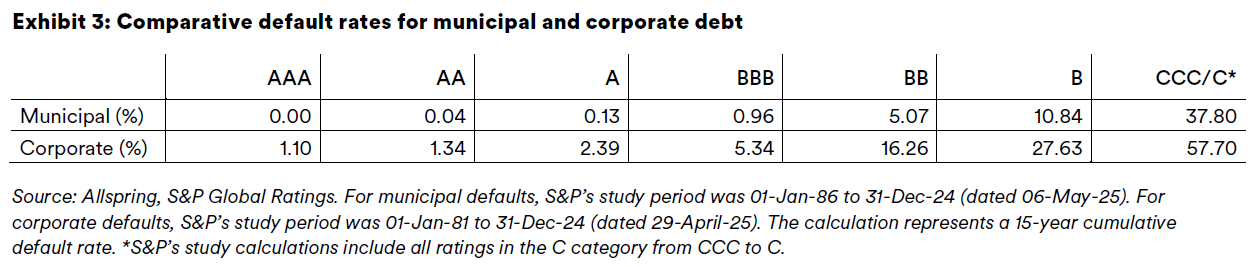
Institutional investor approaches to municipal bonds vary based on their objectives, tax considerations, and investment policies. However, in our view, when place-based objectives are incorporated into portfolio construction, the role of municipal bonds may differ from that of a traditional institutional portfolio. While municipal bond indexes differ from their corporate and core bond counterparts, they have generally exhibited lower default rates and have historically delivered returns comparable to other fixed-income sectors. For example, at every credit rating, municipal bonds have experienced lower default rates than corporate bonds.10
Community priorities
A first step for some investors may be to seek to reduce or avoid exposure to areas of concern that disproportionately impact local communities, such as firearms, predatory lending practices, or coal mining and power generation. In this “minimize harm” approach, simple exclusions can be achieved within individual strategies or portfolio-wide. Custom exclusions can be applied to both low-cost passive strategies and more actively managed solutions but will generally require implementation via separately managed accounts.
Thematic equity and debt funds may play a valuable role in a place-based investment portfolio by providing public market exposure to businesses that are driving innovation on key impact areas such as health equity and access, ed-tech, transportation and mobility, or climate solutions and renewable energy, to name a few. By aligning capital allocation to specific priorities that are most relevant to a community or region, regardless of geography, investors may gain exposure to innovations designed to support local needs in the long-term.
Within fixed income, investors seeking alignment with housing security and affordability objectives may find agency mortgage-backed securities (MBS) relevant, as Fannie Mae and Freddie Mac have mandates to support lending to low-income households and first-time homebuyers, and these loans form part of the collateral underlying agency MBS.11
Likewise, bonds with sustainability-related characteristics may offer opportunities for place-based investing.
- Social bonds often focus on affordable housing, healthcare, education services, or economic development.
- Green bonds often focus on renewable energy, environmentally friendly transit, and water infrastructure.
- Blue bonds often focus on marine conservation, fishery management, and other water-related projects.
While the number of dedicated sustainable bond funds remains small, the field continues to grow rapidly, and green and social bonds are incorporated into many fixed income strategies. In 2025, despite a 19% decline in North America, sustainable bonds saw about $1.1 trillion in new issuance, up from about $679 billion in 2020.12
Non-traditional and private markets
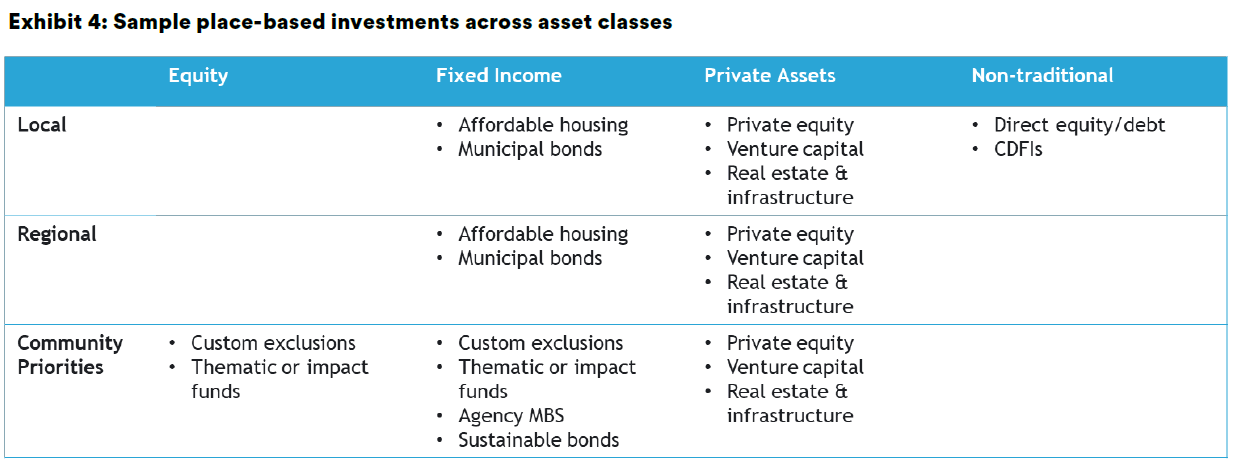
Many place-based investment opportunities exist outside traditional public equity and fixed income. A thoughtful approach to incorporating these place-based considerations will go a long way toward aligning a portfolio with these objectives. Within these asset classes, similar investment approaches may offer a mix of local, regional and community needs alignment.
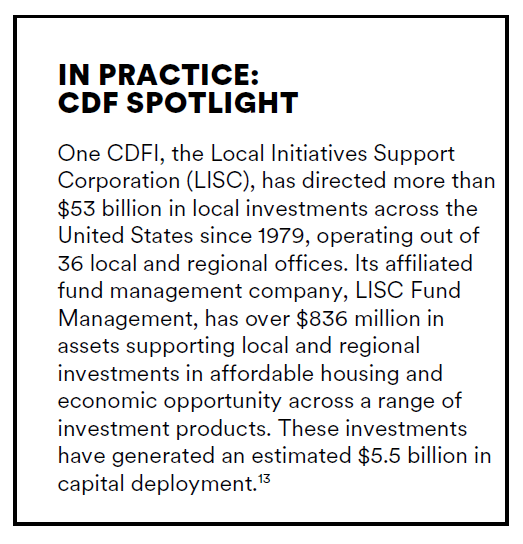
Community Development Financial Institutions (CDFIs) have long been among the primary actors driving capital into local communities. Many have rigorous investment practices and long track records of investing in cities, states and regions.
While many potential investment opportunities with CDFIs are project based, a number of these organizations offer commingled investment vehicles through investment advisory arms. Investors should note that CDFI and similar investments are likely to have concessionary returns relative to other investment opportunities, but for many organizations, they can still be aligned with financial objectives or spending needs.
Private real estate and infrastructure investment vehicles can align with place-based objectives by focusing on a specific municipality or region, or through a more thematic view of investing in affordable multi-family housing, mixed-use development, and local infrastructure.
Private equity, private credit, and venture capital may also support place-based investments in a variety of ways—locally, regionally, or through community priorities. While much of the institutional private equity, private debt, and venture capital market is invested with large, traditional asset managers, many smaller firms are deeply embedded in their communities. Large managers offer scalable access to social and environmental investment themes, and they can be a valuable resource for beginning to shift capital toward impact. Meanwhile, investing with small local firms may require on-the-ground relationships and a more opportunistic approach to investing during fundraising periods. Ultimately, a combination of vehicles may serve place-based investors well, while maintaining flexibility to invest with local players when opportunities arise.
Challenges in place-based investing
Aligning an institutional investment portfolio with place-based objectives is a journey, and organizations should be prepared to face some challenges and tradeoffs as they look to transition their portfolios toward greater local impact.
Many organizations lack the expertise and capacity to develop and implement a place-based investment strategy on their own. In fact, doing so may require long-term relationship building as well as drawing on the expertise of a range of resources and advisors to support these objectives—including their own staff, investment advisors, consultants, and local networks.
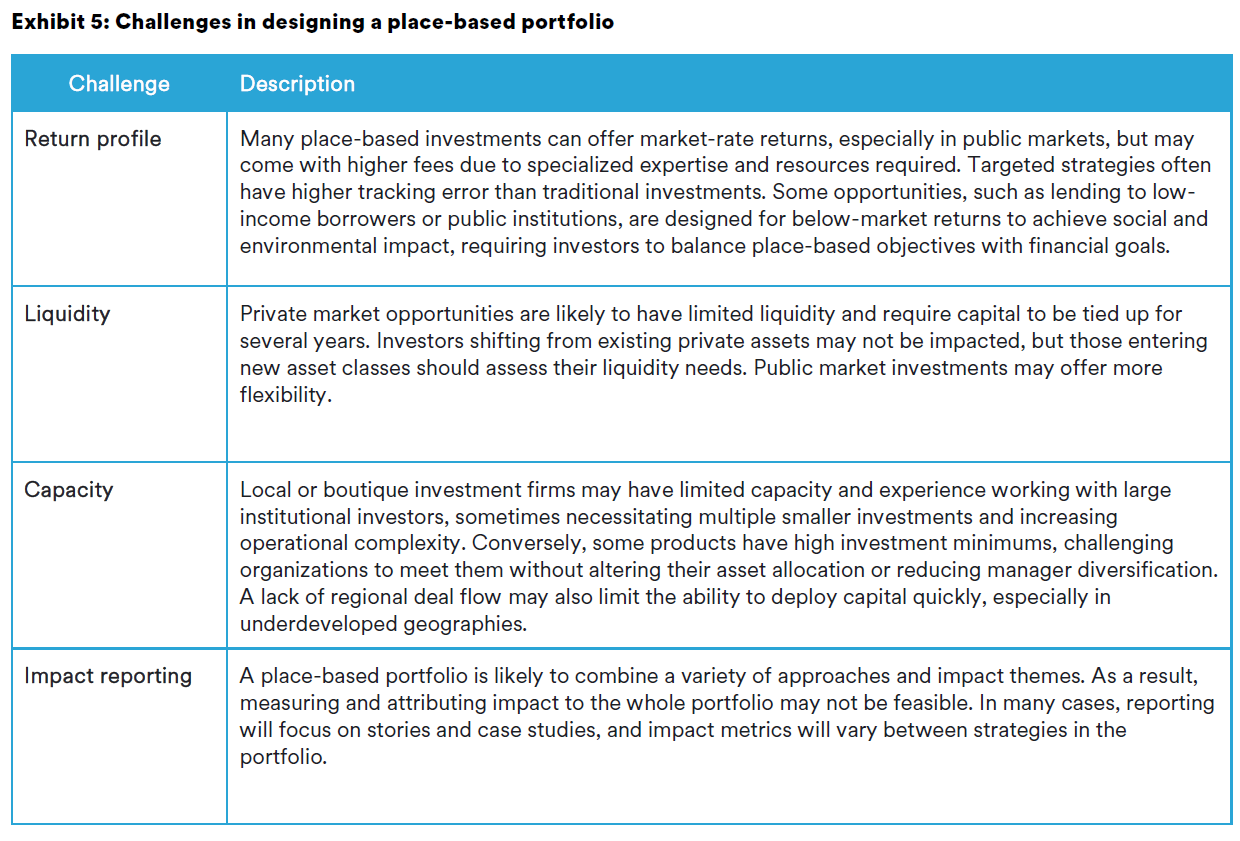
For institutions considering adding place-based investments to the portfolio, there are a number of challenges that investment committees will likely have to address, including return profile, liquidity, and capacity. There is no single right or wrong approach, but tradeoffs must be carefully considered. In addition, impact reporting may prove challenging to do in aggregate. A well-documented approach laid out in an investment policy statement (IPS) or other governing document can help make these decisions more durable and enable an organization to hold itself accountable.
It takes a village: Supporting resources
As noted, a well-structured place-based investment strategy requires long-term relationships and a broad range of expertise. Fortunately, organizations do not have to build those capabilities alone. A robust ecosystem of resources already exists to support this work.
Many institutions already have significant local expertise. Finance teams and investment committees should begin by taking stock of existing relationships, networks, and skill sets. For example, a grant-making organization likely has significant relationships with local institutions whose impact objectives are already closely aligned. Program and grant-making staff may maintain records of local experts.
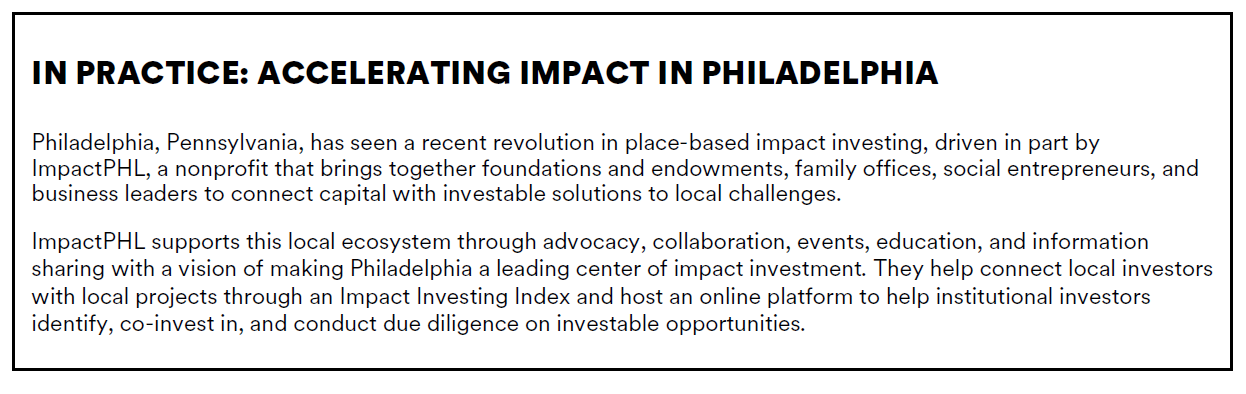
A broad range of local and national coalitions and organizations also work to build capacity for place-based investing and help direct capital toward thriving local economies. CDFIs and credit unions have on-the-ground knowledge and relationships. Many cities have local coalitions dedicated to building place-based investment networks and serving as local centers of excellence. Similarly, local consultants in many regions are focused on mobilizing place-based capital and can provide expertise and support to organizations on this journey.
National and regional organizations such as Living Cities, the Urban Institute, and the Center for Economic Inclusion have deep expertise in issues related to wealth equity. Membership organizations also bring together institutional investors interested in impact investing more broadly, such as the Mission Investors Exchange or the Intentional Endowments Network.
Finally, institutions should not overlook the role their investment advisors can play. While national and international financial firms may not have deep knowledge of every local community, they have often helped other institutions pursue similar objectives and can bring substantial resources, experience, and implementation support.
Engage your OCIO
While no one understands an organization’s mission and values better than its own staff, an outsourced chief investment officer (OCIO) is a critical strategic partner and extension of staff on the path toward place-based investing. SEI has been working with institutional investors to support mission-related objectives for more than 30 years. We view mission-related investing as a journey, and place-based investing is no different.
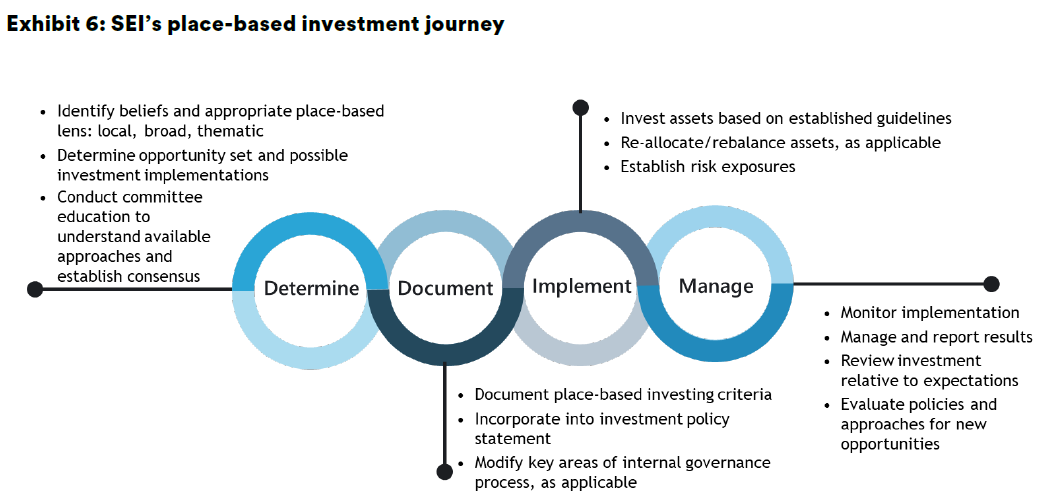
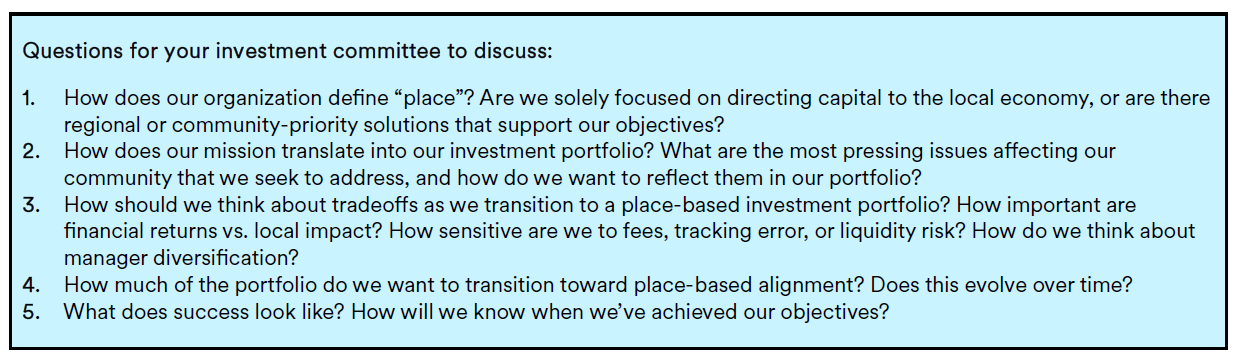
The first step on that journey is to determine what place-based investing means for your organization. For some organizations, that answer is very clear. But for most, it will involve stakeholder discussions and committee education. The organization must decide whether to take a focused local lens or incorporate elements of a community-priorities lens that better align with the financial objectives for a broadly diversified portfolio. These discussions will help to determine the opportunity set and explore possible implementation approaches.
Once stakeholders have reached an agreement on the approach to place-based investing, you will need to document that view. Most organizations publish an IPS or other governance documents to make sure the decisions you make are durable and clear to all committee members and stakeholders. Some institutions may also need to update internal governance processes. Your OCIO can help you work through IPS language, but at the end of the day, this is your organization’s governing document that will be used to set direction and hold both your OCIO and your committee accountable for progress.
After clearly documenting your approach, your OCIO can begin to implement portfolio changes that are aligned with those guidelines and help move the portfolio toward its place-based objectives. This will likely take place over time, but there may be some aspects of your guidelines that can be implemented off the bat, such as exclusions in existing managed account portfolios.
Some organizations will choose to increase place-based investments gradually, tracking toward specific goals. Others may take a more opportunistic approach, selectively reallocating assets during portfolio rebalancing or simply when new opportunities arise. There’s no right or wrong way to align a portfolio, and your OCIO should be able to tailor their advice to your specific situation and objectives.
Finally, the portfolio must be managed over time. Just as financial objectives, asset allocations, and performance targets are revisited periodically, place-based objectives should be reviewed as well. Your committee will monitor implementation over time, while your OCIO can provide periodic reporting and help you understand how your investments are performing relative to expectations. From there, you can evaluate your policies and approaches as organizational needs and the opportunity set evolve.
Conclusion
In summary, the journey toward effective place-based investing requires organizations to thoughtfully define their approach, document decisions in governance frameworks, and implement portfolio changes that reflect their unique objectives and values. Ongoing management and evaluation are essential, as both financial and place-based goals must adapt to evolving organizational priorities and market opportunities. With a clear strategy, robust policies, and continuous oversight, organizations can position their investment portfolios to pursue financial objectives while contributing meaningfully to their chosen communities and missions.
GLOSSARY AND INDEX DEFINITIONS
For financial term and index definitions, please see: https://www.seic.com/ent/imu-communications-financial-glossary
IMPORTANT INFORMATION
This material represents an assessment of the market environment at a specific point in time and is not intended to be a forecast of future events, or a guarantee of future results. This information should not be relied upon by the reader as research or investment advice and is intended for educational purposes only. Diversification may not protect against market risk. There are risks involved with investing, including possible loss of principal.
ESG and Sustainability are not uniformly defined across the industry. Environmental, social and governance (ESG) guidelines may cause a manager to make or avoid certain investment decisions when it may be disadvantageous to do so. This means that these investments may underperform other similar investments that do not consider ESG guidelines when making investment decisions.
Sustainability guidelines may cause a manager to make or avoid certain investment decisions when it may be disadvantageous to do so. This means that these investments may underperform other similar investments that do not consider sustainability guidelines.
A product or strategy that applies sustainability criteria may not invest in certain securities, even when doing so could be financially beneficial, and may sell securities that it might otherwise have been beneficial to continue holding.
Statements that are not factual in nature, including opinions, projections and estimates, assume certain economic conditions and industry developments and constitute only current opinions that are subject to change without notice. Nothing herein is intended to be a forecast of future events, or a guarantee of future results.
Certain economic and market information contained herein has been obtained from published sources prepared by other parties, which in certain cases have not been updated through the date hereof. While such sources are believed to be reliable, neither SEI nor its affiliates assumes any responsibility for the accuracy or completeness of such information and such information has not been independently verified by SEI.
This material is not directed to any persons where (by reason of that person's nationality, residence or otherwise) the publication or availability of this material is prohibited. Persons in respect of whom such prohibitions apply must not rely on this information in any respect whatsoever.
Neither SEI nor its affiliates provide tax advice. Please note that (i) any discussion of U.S. tax matters contained in this communication cannot be used by you for the purpose of avoiding tax penalties; (ii) this communication was written to support the promotion or marketing of the matters addressed herein; and (iii) you should seek advice based on your particular circumstances from an independent tax advisor.
The views contained herein are not to be taken as advice or a recommendation to buy or sell any investment in any jurisdiction. Our outlook contains forward-looking statements that are judgments based upon our current assumptions, beliefs and expectations. If any of the factors underlying our current assumptions, beliefs or expectations change, our statements as to potential future events or outcomes may be incorrect. We undertake no obligation to update our forward-looking statements.
Information in the U.S. is provided by SEI Investments Management Corporation (SIMC), a wholly owned subsidiary of SEI Investments Company (SEI).
Information in Canada is provided by SEI Investments Canada Company, a wholly owned subsidiary of SEI Investments Company (SEI), and the Manager of the SEI Funds in Canada.
In the UK and the EEA this information issued in the UK by SEI Investments (Europe) Ltd, 1st Floor, Alphabeta, 14-18 Finsbury Square, London EC2A 1BR which is authorised and regulated by the Financial Conduct Authority. Investments in SEI Funds are generally medium- to long-term investments.
This information is made available in Latin America, the Middle East and Australia FOR PROFESSIONAL (non-retail) USE ONLY by SIEL.
SIEL is not licensed under Israel’s Regulation of Investment Advising, Investment Marketing and Portfolio Management Law, 5755-1995 (the “Advice Law”) and does not carry insurance pursuant to the Advice Law. No action has been or will be taken in Israel that would permit a public offering or distribution of the SEI Funds mentioned in this email to the public in Israel. This email and any of the SEI Funds mentioned herein have not been approved by the Israeli Securities Authority (the “ISA”).
Issued in South Africa by SEI Investments (Europe) Ltd, an authorised financial services provider (FSP No. 9796). This material is provided for general information and educational purposes only and does not constitute financial advice as contemplated in the Financial Advisory and Intermediary Services Act, 2002. It has not been prepared with regard to the investment objectives, financial situation or particular needs of any individual investor. Any reference to portfolio positioning represents SEI's investment views at the date of publication and may differ between portfolios and mandates. Investors should obtain appropriate professional advice before making an investment decision.
This document has not been registered as a prospectus with the Monetary Authority of Singapore.
The Shares may not be offered, sold or delivered directly or indirectly in the US or to or for the account or benefit of any US Person except pursuant to an exemption from, or in a transaction not subject to, the registration requirements of the Securities Act of 1933 and any applicable state laws.
Any questions you may have in relation to its contents should solely be directed to your Distributor. If you do not know who your Distributor is, then you cannot rely on any part of this document in any respect whatsoever.