Quarterly economic outlook: A higher-for-longer economy.
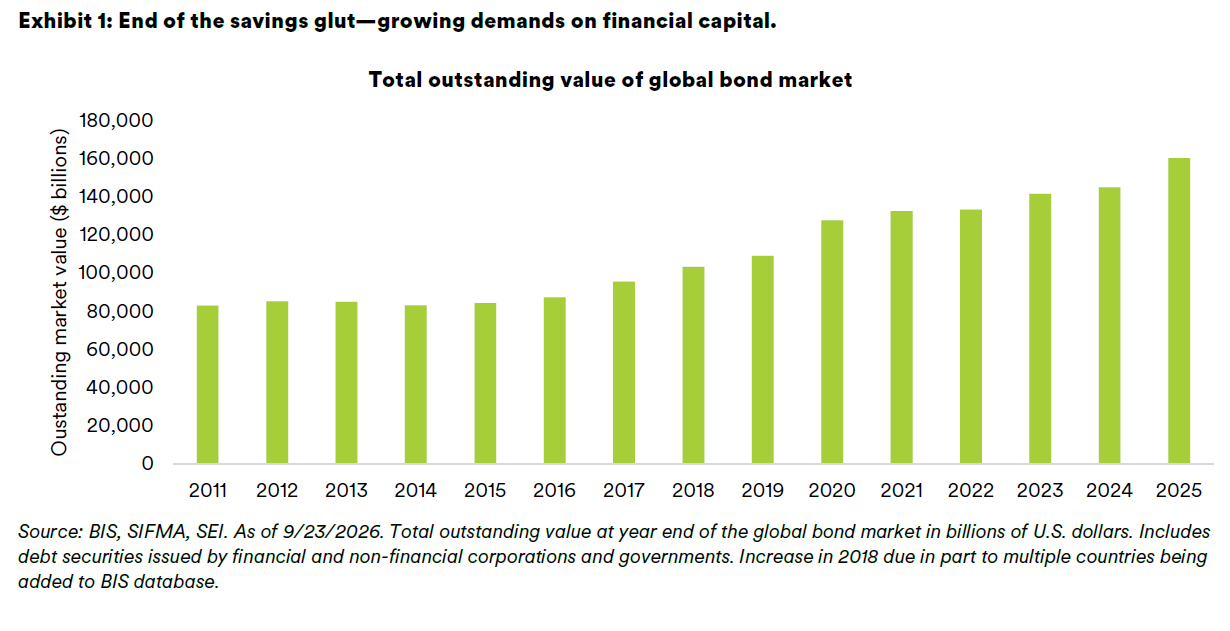
The third-quarter move in interest rates has been a global phenomenon, driven by higher “real” rates (bond yields excluding inflation) and, depending on the model used, additional risk compensation for inflation and real-rate risks. Higher real rates make sense given the historic physical investment boom occurring in the global economy (primarily within AI-related areas but also with regard to military and other infrastructure expenditures) that has been accompanied by persistent government budget deficits. The resulting demands for financial capital have been intense, marking a sharp departure from the so-called global savings glut of the prior two decades.
This is evident in the total amount of global debt outstanding (Exhibit 1), which has been running ahead of global economic output in recent years.
In response to the upward pressure on bond yields—and out of precaution over inflation (given AI-buildout demands and higher energy and related prices arising from wars in the Middle East and Eastern Europe)—numerous central banks have raised policy rates in recent months.
However, by almost any measure, financial conditions are still quite accommodative, as shown in Exhibit 2.
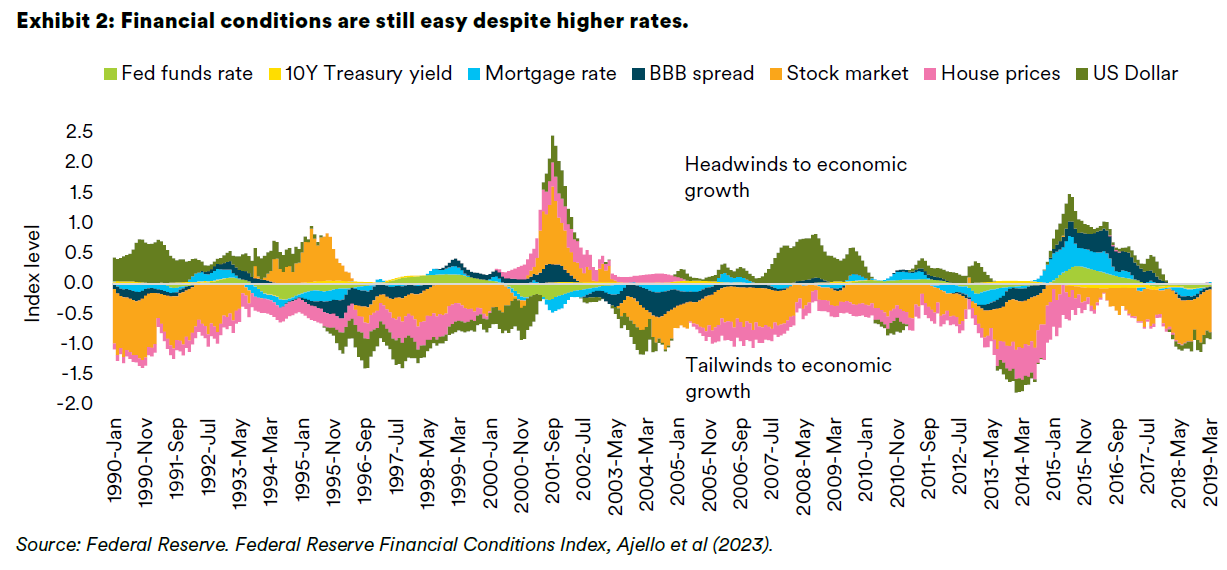
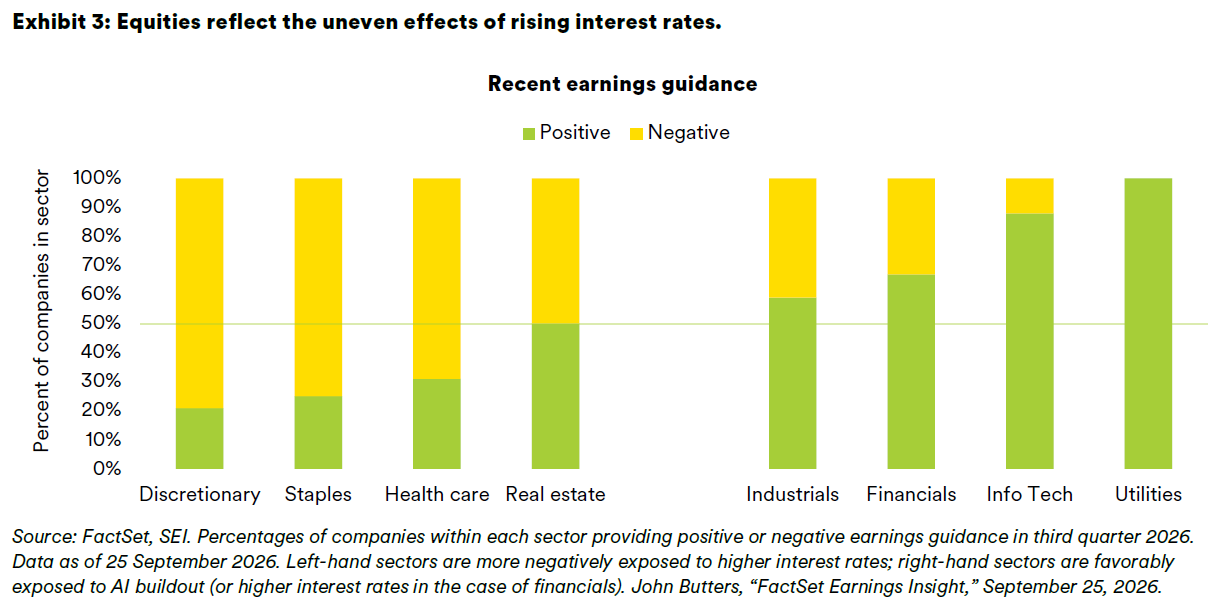
Taken together, these dynamics point to ongoing upward pressure on interest rates. Admittedly, the growth dynamic is still somewhat narrow as it is heavily dependent on the AI buildout and central-government expenditures. And some areas—such as residential real estate, consumer borrowing, lower-quality debt, and industries that tend to fare better in falling-rate environments—have faced headwinds this year, as shown in Exhibit 3.i But, in the aggregate, the global economy appears strong enough to absorb the regime shift in interest rates, unless monetary or fiscal policies become far more restrictive.
These dynamics have created a very different economic and financial environment than the one that prevailed for most of the 21st century. As we’ve previously pointed out, investors need to be selective and remain attuned to likely winners and losers.
As hockey great Wayne Gretzky wrote in his autobiography, it’s important to skate to where the puck is going, not where it’s been.ii And in the current environment, that includes watching inflation risks closely.
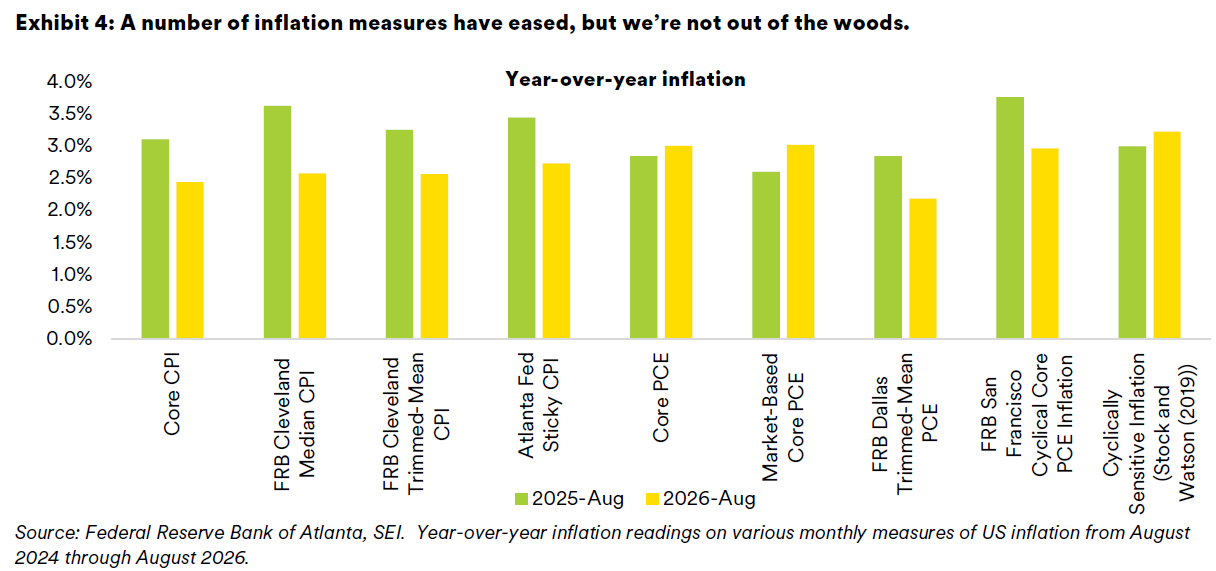
Despite tariffs, wars, stubbornly high energy prices, and AI-driven demands for materials and electricity, we have yet to see significant knock-on effects on broader measures of inflation. Somewhat encouragingly, as shown in Exhibit 4, most inflation measures have cooled over the past year. But as Exhibit 4 also shows, using the U.S. as an example, that’s not true across the board, and inflation is still well above where central bankers would prefer to see it. Making an assumption that recent improvements will continue unabated would require quite a leap of faith (never a good basis for investment strategy). Importantly, we have seen second-order effects of the energy shock in various measures of transport prices, the AI buildout in manufacturing prices, and tariff impacts on the prices of some goods. Fertilizer-supply disruptions arising from energy shortages and weather risks related to an extreme El Nino pattern are also likely to continue pushing the prices of certain agricultural goods higher.iii And of course, the potential for additional tariffs from the U.S. administration and countermeasures from its trade partners add yet another near-term risk to the outlook for prices.
However, the more important (and largely underappreciated, in our view) story for the longer-term inflation outlook is labor demand and supply. This might surprise some investors given the exceptionally quiet state of many countries’ labor markets, where workers are experiencing a “low-hire, low-fire” environment. Some economists view this as a risky situation for worker employment and incomes. Researchers at the Kansas City Federal Reserve, for example, recently opined that the U.S. labor market was currently “stable but fragile” and that an economic downturn could cause the unemployment rate to roughly double. That caution is understandable. However, in our view, labor market risks run both ways, with shifting population dynamics as a key factor. As we noted in our second-quarter outlook, workforces in numerous countries are expected to shrink significantly in the coming years and decades as Baby Boomers leave the workforce and fertility rates continue to decline. Taken together with drastically lower immigration rates, there appears to be a meaningful and widespread labor-market supply crunch ahead.
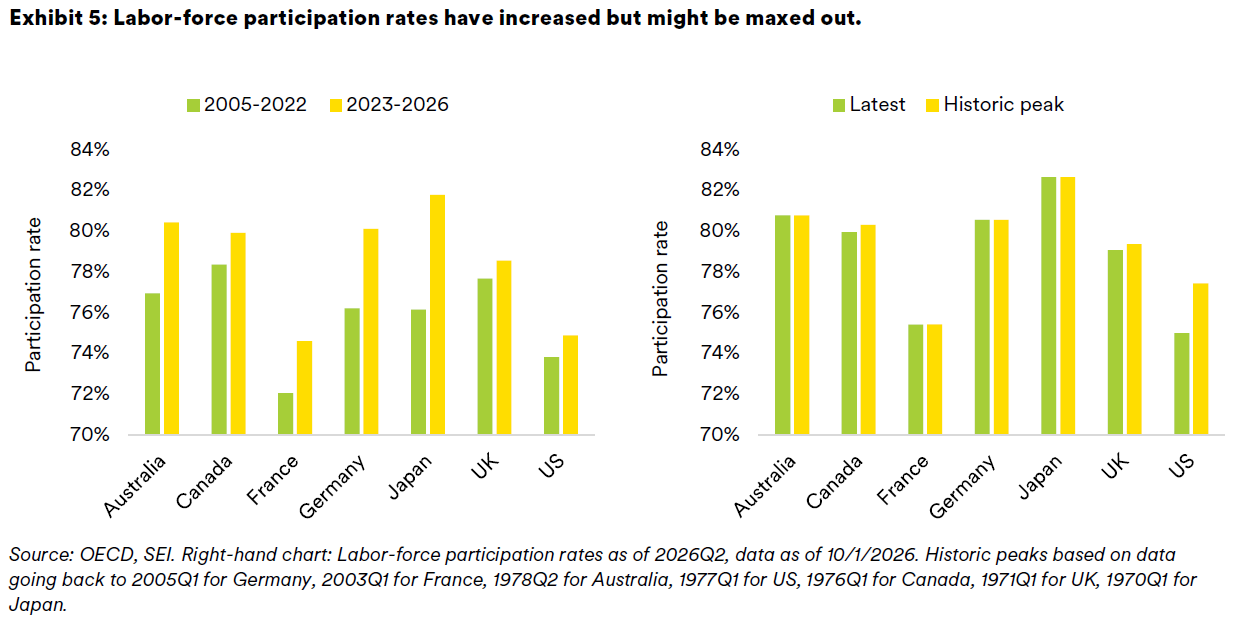
Meanwhile, labor-force participation rates in many advanced economies (with the exception of the U.S.) have already reached or are approaching all-time highs, as shown in Exhibit 5. Outside the U.S., there appears to be limited scope for workers reentering the labor force to help ease supply pressures.
At the same time, the number of people aged 15 to 64 in high-income countries has already started what’s projected to be a long, steady decline, as shown in Exhibit 6.
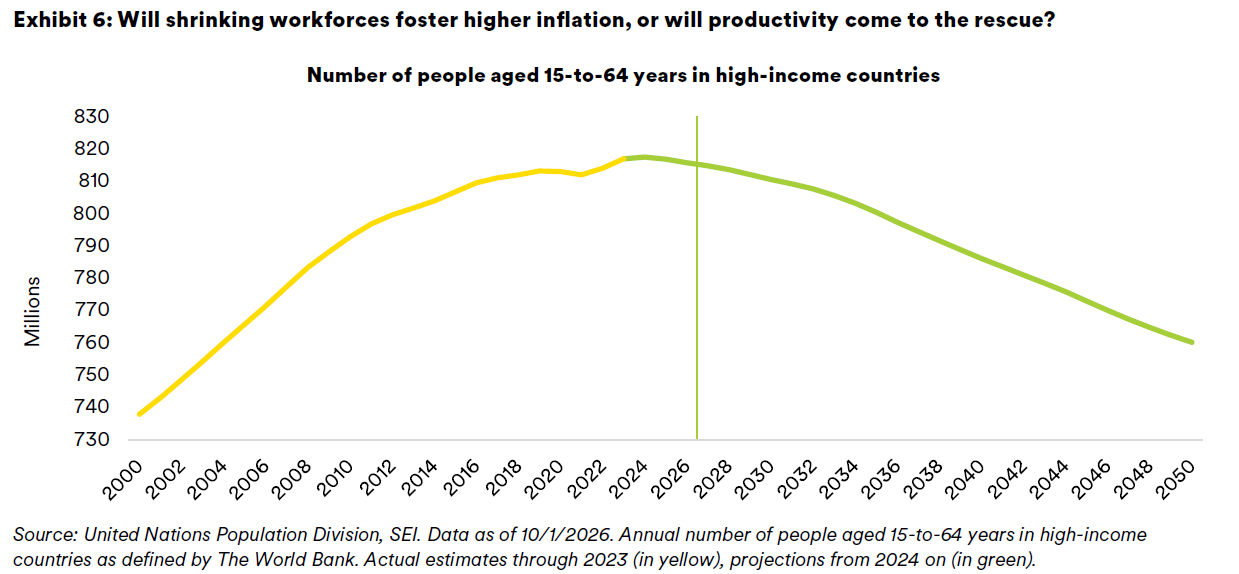
A maxed-out participation rate with a declining number of working-age people is likely to create serious labor-supply pressures in the years and decades ahead. Of course, it’s important to note that demographics, while slow-moving, aren’t set in stone. For example, while Japan and South Korea are seeing early signs of success incentivizing higher marriage and fertility rates, it’s taken some serious financial incentives.iv We expect policy measures aimed at slowing these trends will receive consideration in other countries as well, if not in this decade, then perhaps the next. But slowing, much less reversing, this trend will take political will, well-designed incentives, and time. And of course, these types of measures could put additional pressure on government budget deficits if enacted.
As long as economic activity remains robust (even if somewhat narrow), supply pressures (including within the labor market) pose important risks to the inflation outlook. The underlying dynamics can be complex, but the investment upshots are straightforward. We maintain our focus on taking advantage of diversification benefits but also remain attuned to the economic environment (including inflation!) and its likely winners and losers. We also believe that investors should be appropriately selective in an environment that looks notably different from the one that has prevailed for most of this century.
GLOSSARY AND INDEX DEFINITIONS
For financial term and index definitions, please see: https://www.seic.com/ent/imu-communications-financial-glossary
IMPORTANT INFORMATION
This material represents an assessment of the market environment at a specific point in time and is not intended to be a forecast of future events or a guarantee of future results. Positioning and holdings are subject to change. All information as of the date indicated. There are risks involved with investing, including possible loss of principal. This information should not be relied upon by the reader as research or investment advice (unless you have otherwise separately entered into a written agreement with SEI for the provision of investment advice) nor should it be construed as a recommendation to purchase or sell a security. The reader should consult with their financial professional for more information.
Statements that are not factual in nature, including opinions, projections and estimates, assume certain economic conditions and industry developments and constitute only current opinions that are subject to change without notice. Nothing herein is intended to be a forecast of future events, or a guarantee of future results.
Certain economic and market information contained herein has been obtained from published sources prepared by other parties, which in certain cases have not been updated through the date hereof. While such sources are believed to be reliable, neither SEI nor its affiliates assume any responsibility for the accuracy or completeness of such information and such information has not been independently verified by SEI.
There are risks involved with investing, including loss of principal. The value of an investment and any income from it can go down as well as up. Investors may get back less than the original amount invested. Returns may increase or decrease as a result of currency fluctuations. Past performance is not a reliable indicator of future results. Investment may not be suitable for everyone. Diversification may not protect against market risk.
Index returns are for illustrative purposes only and do not represent actual investment performance. Index performance returns do not reflect any management fees, transaction costs or expenses. Indexes are unmanaged, and one cannot invest directly in an index. Past performance does not guarantee future results.
This material is not directed to any persons where (by reason of that person's nationality, residence or otherwise) the publication or availability of this material is prohibited. Persons in respect of whom such prohibitions apply must not rely on this information in any respect whatsoever.
The information contained herein is for general and educational information purposes only and is not intended to constitute legal, tax, accounting, securities, research or investment advice regarding the strategies or any security in particular, nor an opinion regarding the appropriateness of any investment. This information should not be construed as a recommendation to purchase or sell a security, derivative or futures contract. You should not act or rely on the information contained herein without obtaining specific legal, tax, accounting and investment advice from an investment professional.
The views contained herein are not to be taken as advice or a recommendation to buy or sell any investment in any jurisdiction. Our outlook contains forward-looking statements that are judgments based upon our current assumptions, beliefs, and expectations. If any of the factors underlying our current assumptions, beliefs or expectations change, our statements as to potential future events or outcomes may be incorrect. We undertake no obligation to update our forward-looking statements.
Information in the U.S. is provided by SEI Investments Management Corporation (SIMC), a wholly owned subsidiary of SEI Investments Company (SEI).
Information in Canada is provided by SEI Investments Canada Company, a wholly owned subsidiary of SEI Investments Company (SEI), and the Manager of the SEI Funds in Canada.
SEI sources data directly from FactSet, Lipper, and BlackRock unless otherwise stated.
Information issued in the UK by SEI Investments (Europe) Limited, 1st Floor, Alphabeta, 14-18 Finsbury Square, London EC2A 1BR which is authorised and regulated by the Financial Conduct Authority. Investments in SEI Funds are generally medium- to long-term investments.
This information is made available in Latin America and the Middle East FOR PROFESSIONAL (non-retail) USE ONLY by SIEL.
Any questions you may have in relation to its contents should solely be directed to your Distributor. If you do not know who your Distributor is, then you cannot rely on any part of this document in any respect whatsoever.
Issued in South Africa by SEI Investment (South Africa) (Pty) Limited FSP No. 13186 which is a financial services provider authorised and regulated by the Financial Sector Conduct Authority (FSCA). Registered office: 3 Melrose Boulevard, 1st Floor, Melrose Arch 2196, Johannesburg, South Africa.
This material is intended for information purposes only and the information in it does not constitute financial advice as contemplated in terms of the Financial Advisory and Intermediary Services Act.
SIEL is not licensed under Israel’s Regulation of Investment Advising, Investment Marketing and Portfolio Management Law, 5755-1995 (the “Advice Law”) and does not carry insurance pursuant to the Advice Law. No action has been or will be taken in Israel that would permit a public offering or distribution of the SEI Funds mentioned in this email to the public in Israel. This document and any of the SEI Funds mentioned herein have not been approved by the Israeli Securities Authority (the “ISA”).
The SEI Global Assets Fund Plc, SEI Global Investments Fund Plc, and SEI Global Master Fund Plc (the “SEI UCITS Funds”) are structured as open-ended collective investment schemes and are authorised in Ireland by the Central Bank as a UCITS pursuant to the UCITS Regulations. The SEI UCITS Funds are managed by SEI Investments, Global Ltd (“SIGL”). SIGL has appointed SEI Investments (Europe) Ltd (“SIEL”) to provide general distribution services in relation to the SEI UCITS Funds either directly or through the appointment of other sub-distributors. The SEI UCITS Funds may not be marketed to the general public except in jurisdictions where the funds have been registered by the relevant regulator. The matrix of the SEI UCITS fund registrations can be found here seic.com/GlobalFundRegistrations.
No offer of any security is made hereby. Recipients of this information who intend to apply for shares in any SEI UCITS Fund are reminded that any such application may be made solely on the basis of the information contained in the Prospectus. Please refer to our latest Full Prospectus (which includes information in relation to the use of derivatives and the risks associated with the use of derivative instruments), Key Investor Information Documents and latest Annual or Semi-Annual Reports for more information on our funds. This information can be obtained by contacting your Financial Adviser or using the contact details shown above.